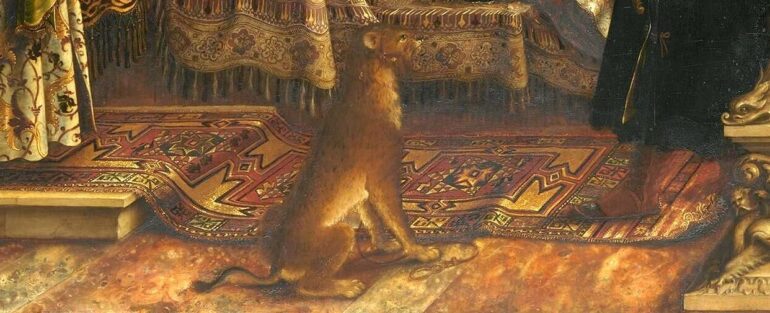
The filling of a surface with a pattern made of stars is probably going back to first civilizations. A multitude of Roman mosaics show us already the diversity of patterns that can be created by using stars. Anatolian carpets also used several type of star tessellation. A specific pattern shown below, forming large squares between stars, seems to have been popular enough be exported into western Europe as of the 15th century or before.
The German painter Hans Burgkmair has depicted such a carpet in his painting “The Story of Esther” dated 1528, conserved in the Alte Pinakhotek in Münich. The painter demonstrates his skills not only in the composition and perspective’s space effects but also in his rendering of the material structures of the pavement, marbles, metal, rich tissues, jewelry and animal furs. In that context an Anatolian carpet is laid at the left front of the picture.
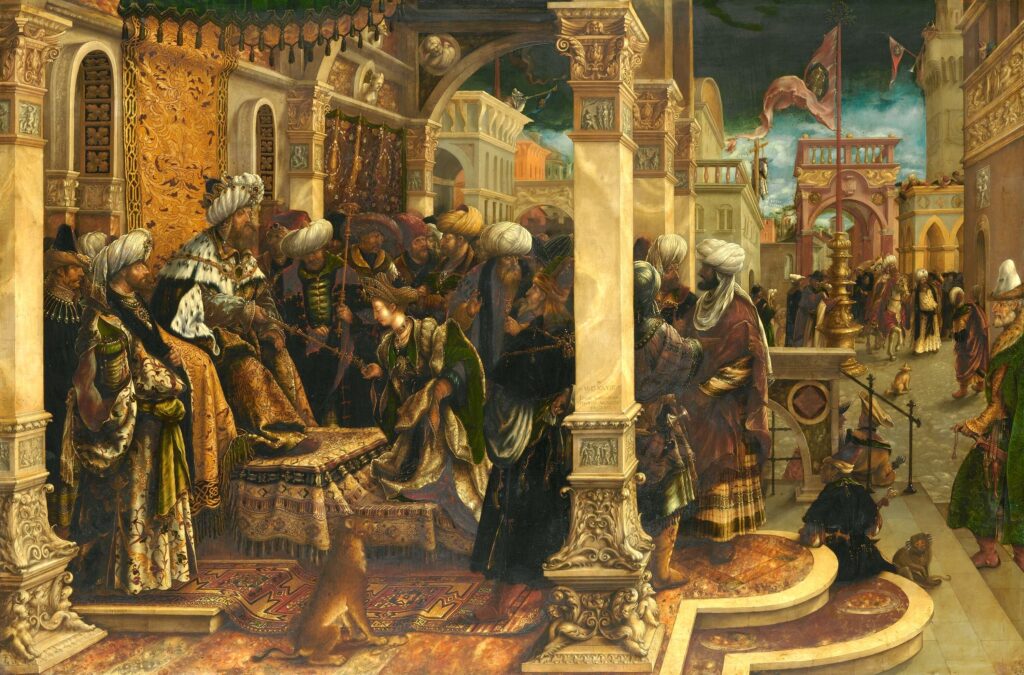
Hans Burgkmair. The Story of Esther 1528. Alte Pinakothek. Munich
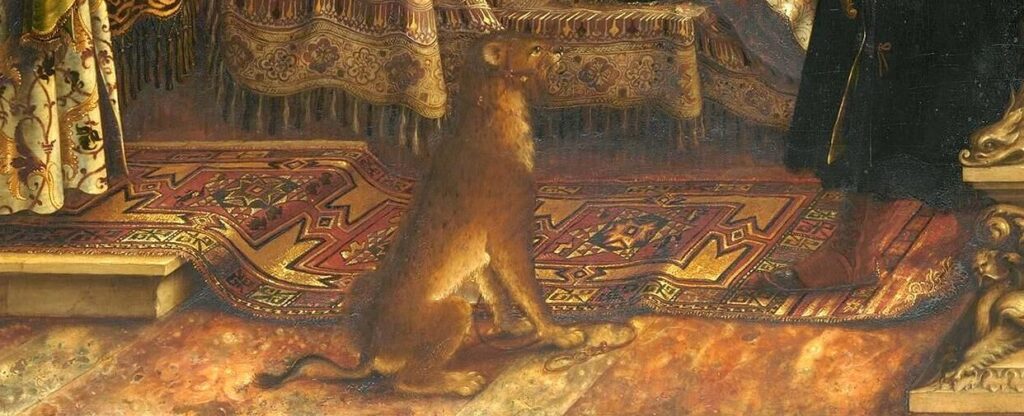
In the detail view below one can recognize the mastery of the painter who has depicted faithfully not only the light and shade effects on the rug, but also, its minute motives and somehow the handle rendered with the curved parts. Through its format, colors and design the carpet appears to be related to central Anatolian rugs produced in the Aksaray-Cappadocia area in the later centuries.
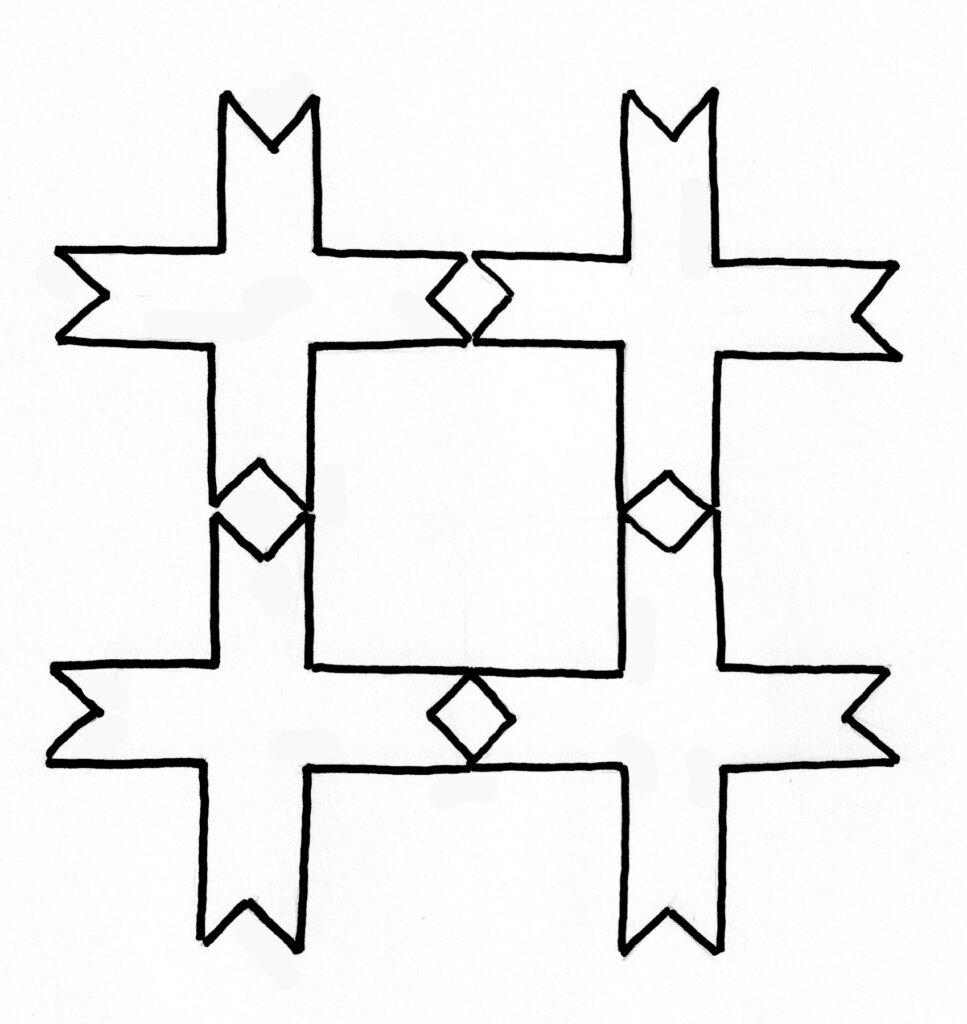
An attempt to the reconstruction of the design is shown in the sketch below.
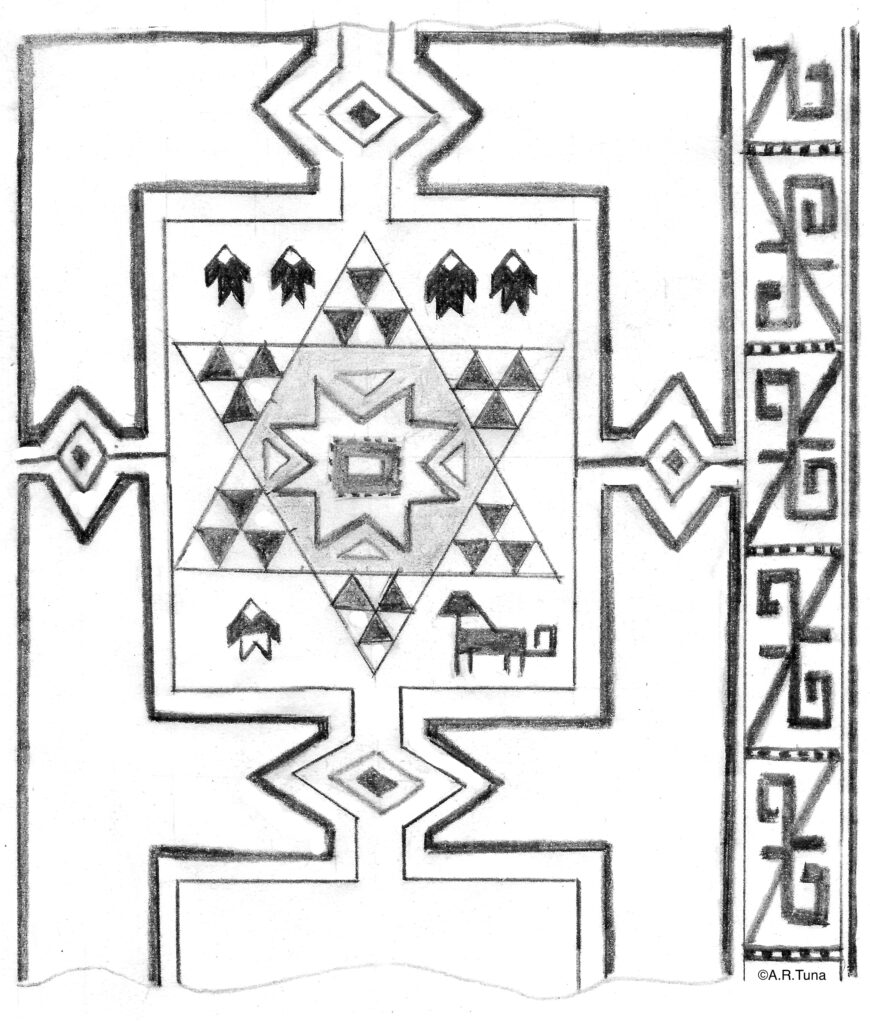
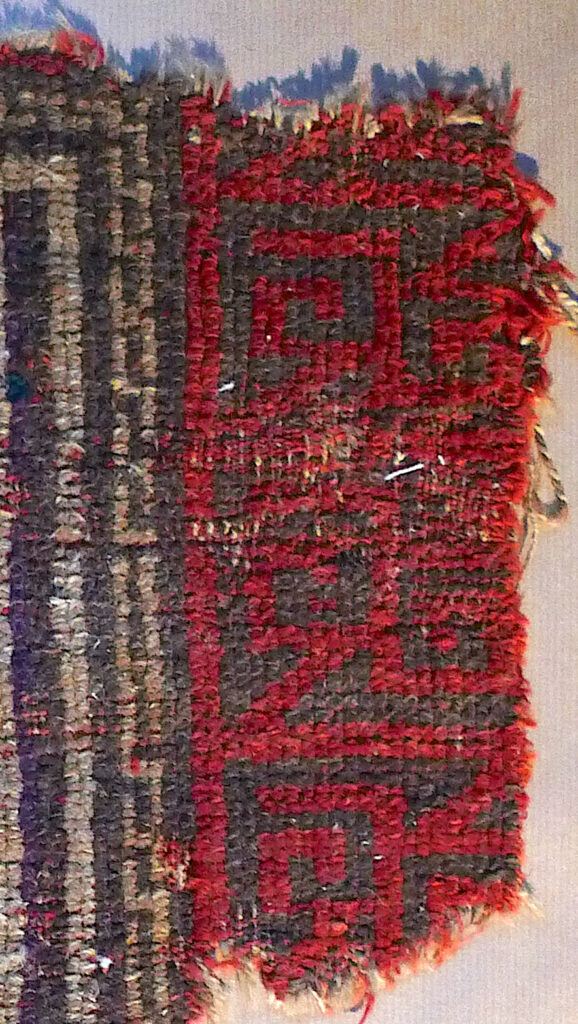
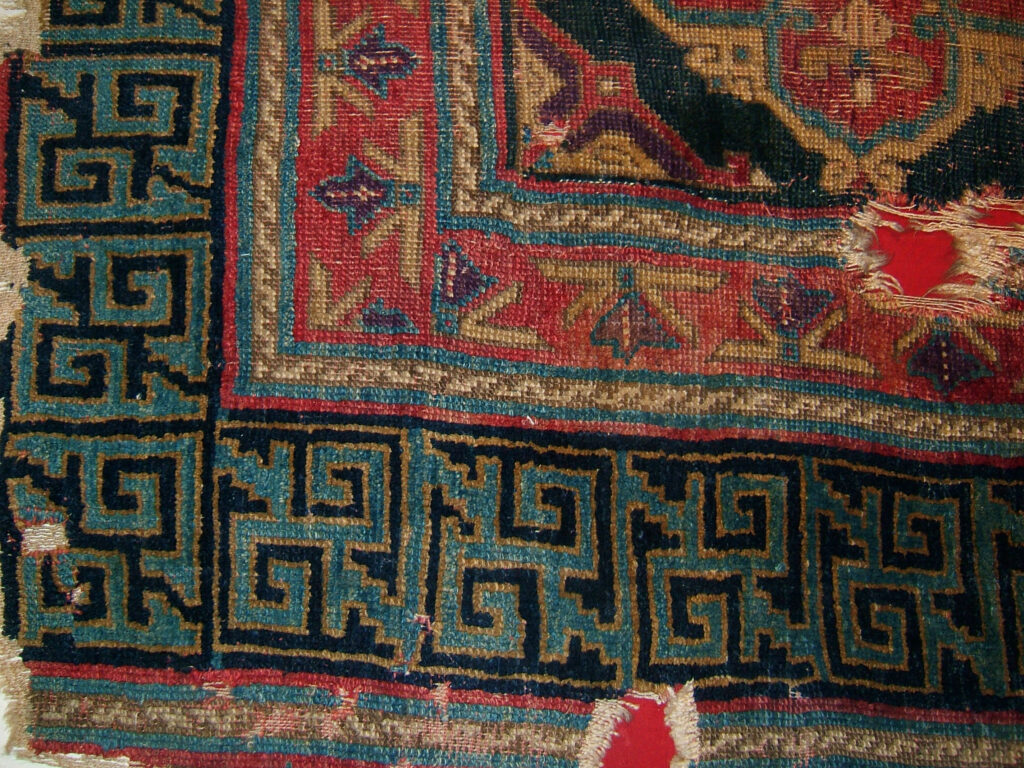
The composition of the field is centered on the square between the stars. These latter are shown only partially along both borders. This set-up gives prominence in perception to the central square which appears dominant with diamond-like extensions from its four sides. The partial stars remain at second level as a yellow background. The central square contains a David star adorned with small triangles inside its six branches. These motifs are probably executed by offset knotting. At its center, it contains a more conventional star. Small animal and other leaf-like motifs are placed at four corners outside the main star, fully in the old Turkic tradition. The border which can be interpreted as a dragon or two half “elibelinde” in opposition, presents a positive negative reading. Its design is well known from other early examples that reached our time (for instance the Lamm Fustat fragment RKM-322-1935 or the Konya Seljuk rug KEM Inv.860-861-1033).
Fustat Fragment Border
Konya Seljuk carpet border
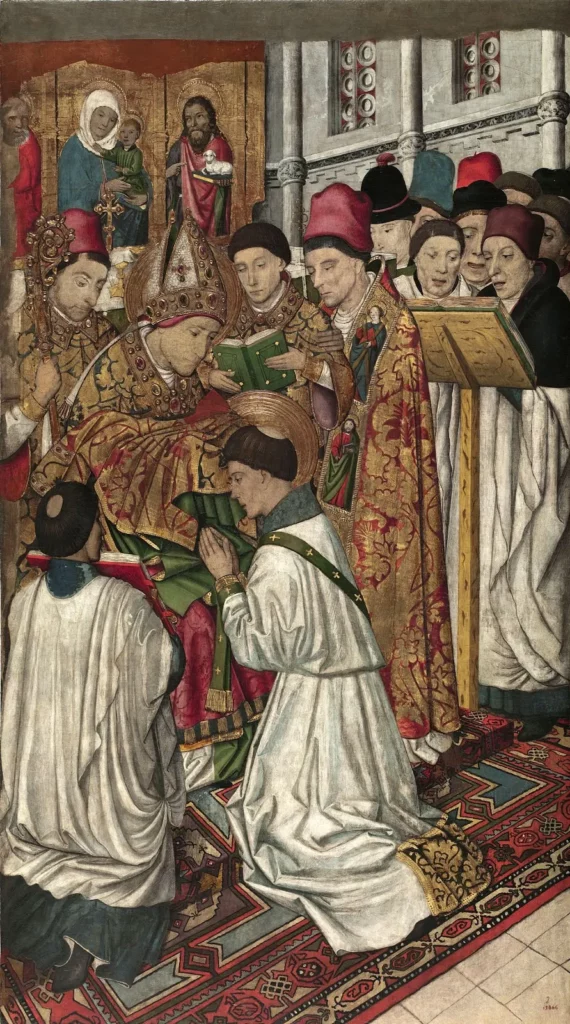
The Burgkmair painting is not the earliest depiction of a carpet with star and square pattern. The Spanish master Jaume Huguet had already depicted a similar carpet in the late 15th century in his painting St. Vincent Ordained by St. Valerius dated 1455-1460. (Museu Nacional d’Art de Catalunya). There, the stars are in blue color. The border is seen on examples of large pattern Holbein carpets conserved in the Türk ve Islam Museum in Istanbul.
Slightly later, the painting below dated c.1460-80 from Rogier Van der Weyden school, is in the collections of the Musée d’Art d’Angers. Similar to the Burgkmair example, the stars are in yellow, giving the impression of a background around the central medallions.
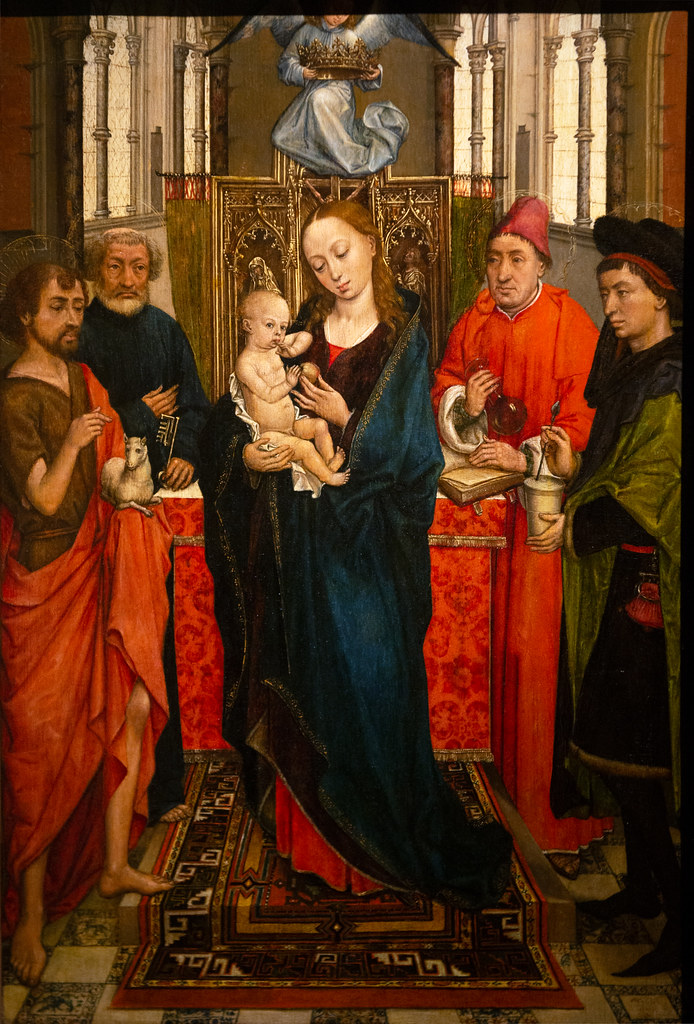
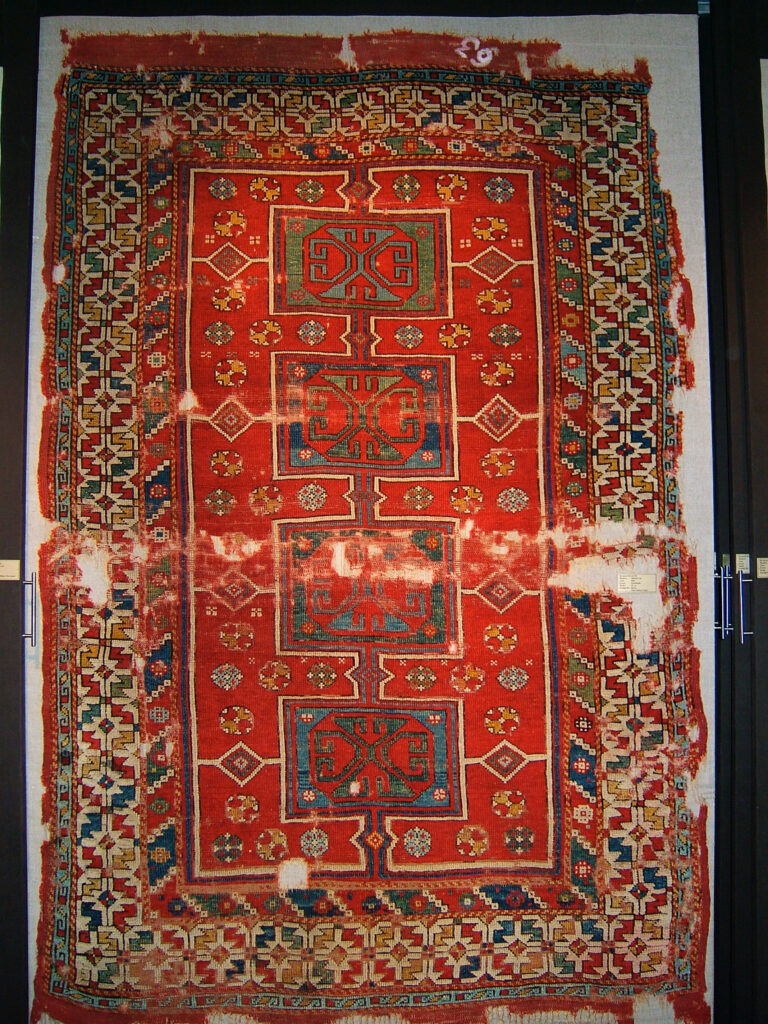
The star and square pattern continued to be frequently used on Anatolian carpets in later centuries; however the overall composition has evolved through the prominence of the central medallion and its diamond shape extensions formed by the tips of the stars. The following two carpets explain well the start of the transition.
West Anatolian carpet, 16-17th c.Ankara Vakiflar Museum inv. no 1998-16.320
West Anatolian carpet 18th c. sold by Austria Auction Company
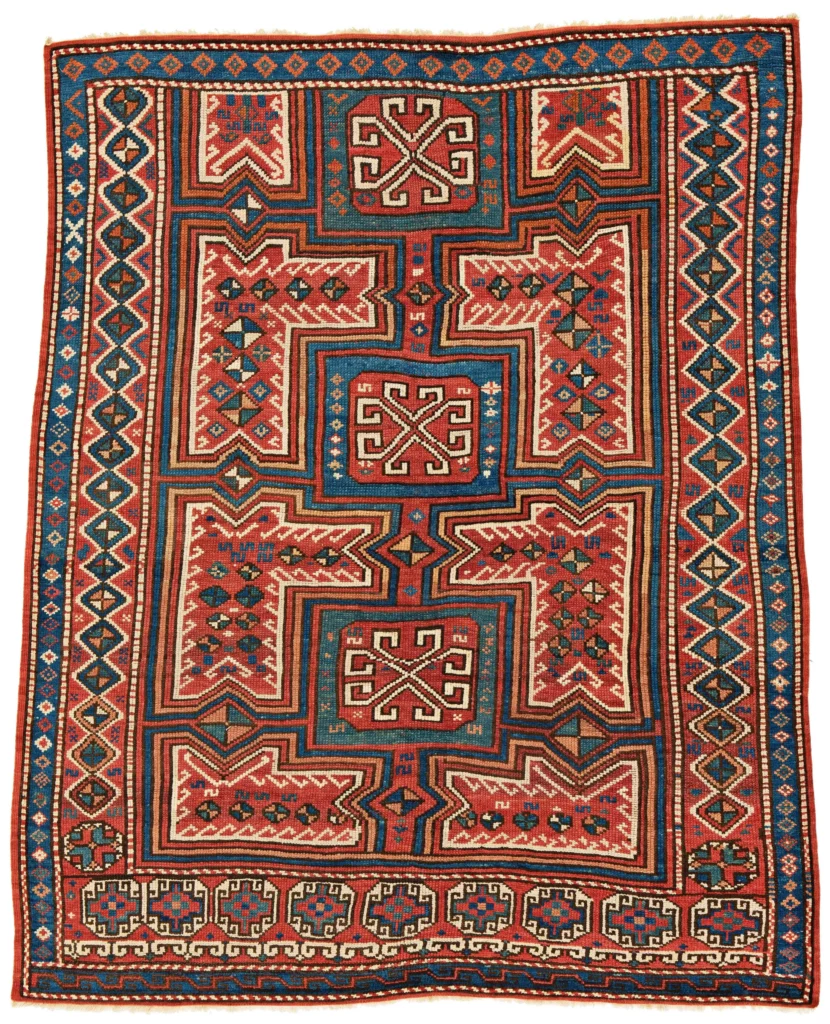
These both carpets show an early phase of the design transition where the stars are still perceptible with marked contours as in the paintings. The Seljuk göl that will be present in most of the later examples is probably coming from another early example not appearing in the paintings.
At a later stage the stars disappear to the benefit of the central medallion which keeps diamond or simple hook extensions on two or four sides. The tips of the stars remain either on the horizontal or vertical placement. The idea of the connecting medallions remain.
Carpet. Central Anatolia. Published as Plate 14 in Brüggemann &Böhmer’s “Anatolian carpets”carpets of peasants and Nomads of Anatolia”
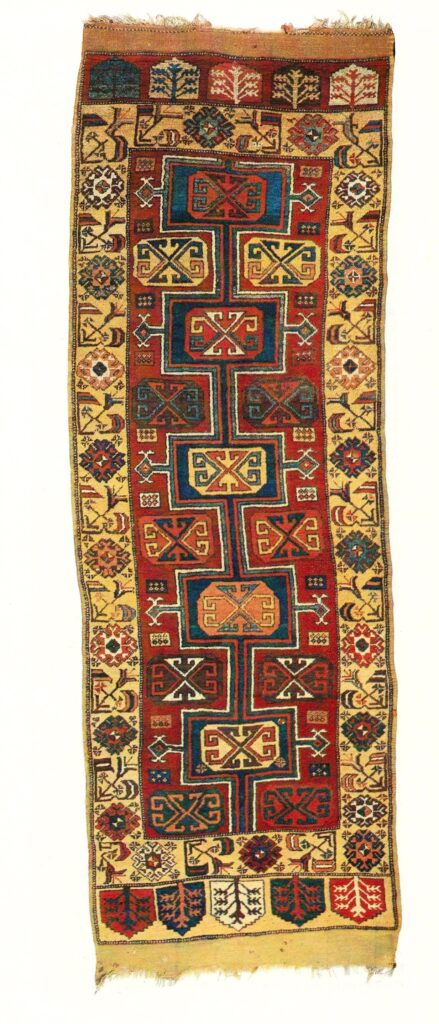
Carpet. Cappadocia region. Previously Ayan Gülgönen collection. Several similar carpets from Cappadocia have been published.
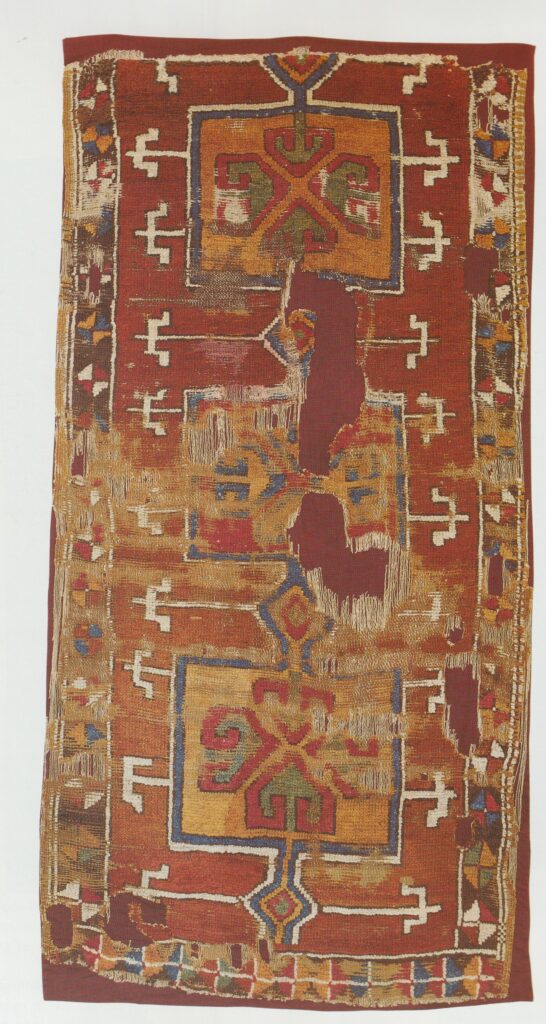
Based on the above examples, it appears that the design of the carpets below from Karapinar or Ladik take its source from the star and square pattern. Some authors have interpreted them as influenced by Persian gardens but the historical continuity discovered through paintings drive us to the right origin.
Karapinar carpet c.1700 published in the Battenberg catalog
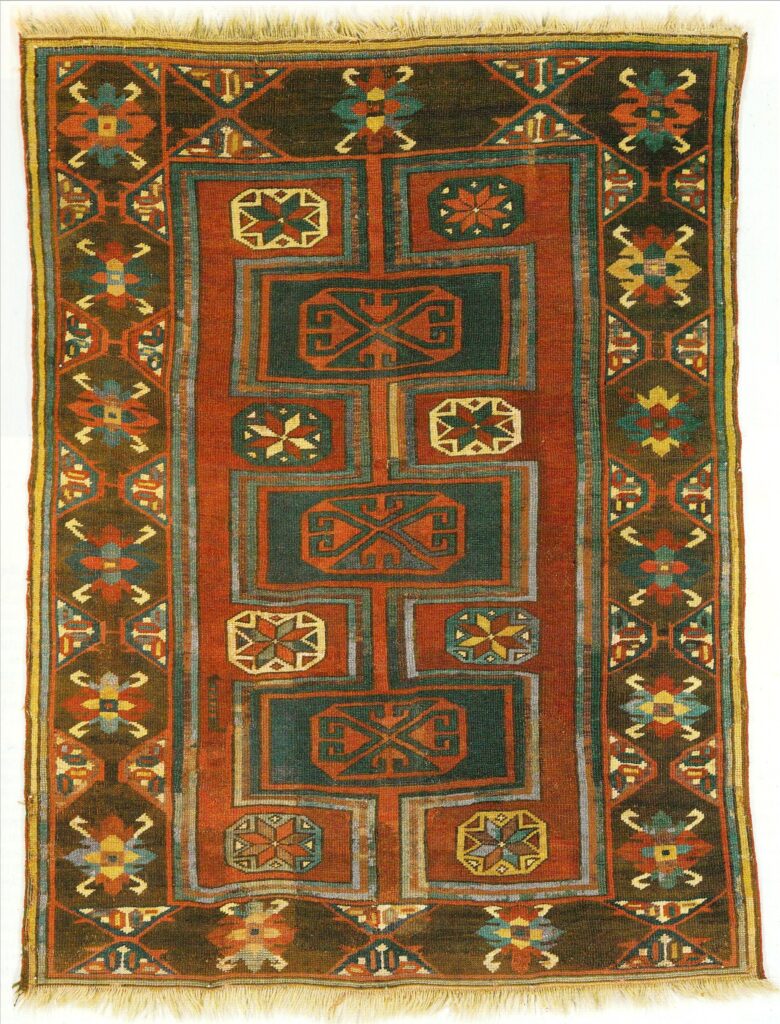
Ladik carpet advertised on Rugrabbit
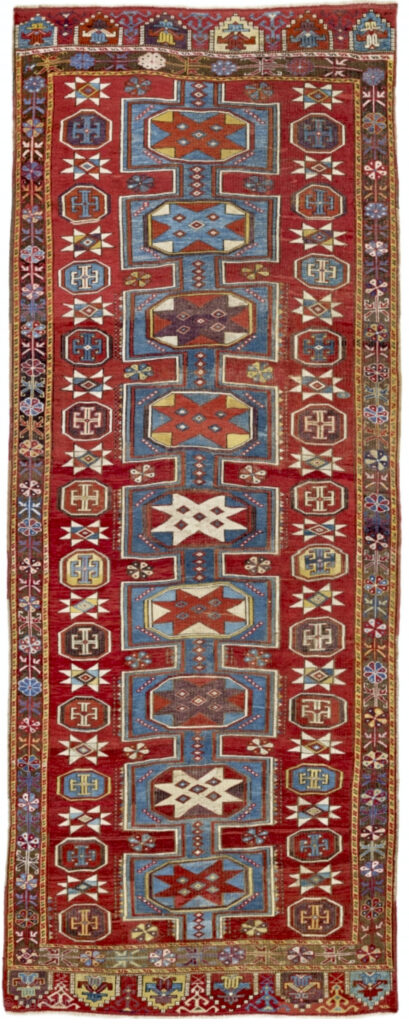
Obviously the design evolutions are not occurring at a linear timescale, but rather depending on the regions and communities. Older designs, as in the case of the western Anatolian examples survive probably till 19th century, while in central Anatolia, the designs seem to have evolved on a faster time scale.